
Protein Molecular Weight Markers

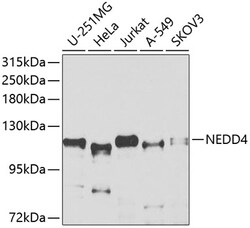
ABclonal Technology NEDD4 Rabbit pAb

This gene is the founding member of the NEDD4 family of HECT ubiquitin ligases that function in the ubiquitin proteasome system of protein degradation. The encoded protein contains an N-terminal calcium and phospholipid binding C2 domain followed by multiple tryptophan-rich WW domains and, a C-terminal HECT ubiquitin ligase catalytic domain. It plays critical role in the regulation of a number of membrane receptors, endocytic machinery components and the tumor suppressor PTEN.

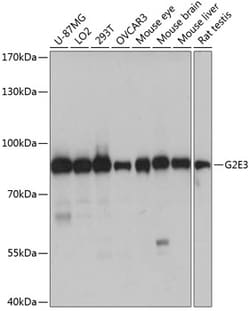
ABclonal Technology G2E3 Rabbit pAb
Predicted to enable ubiquitin protein ligase activity. Predicted to be involved in apoptotic process and protein ubiquitination. Predicted to act upstream of or within blastocyst development, negative regulation of intrinsic apoptotic signaling pathway, and protein polyubiquitination. Located in Golgi apparatus and cytosol.
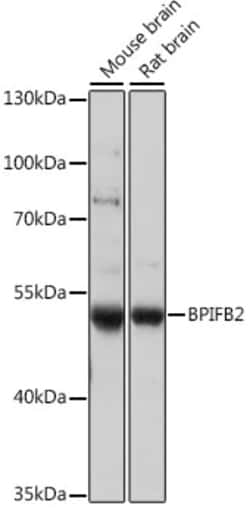
ABclonal Technology BPIFB2 Rabbit pAb
This gene encodes a member of the lipid transfer/lipopolysaccharide binding protein (LT/LBP) gene family. It is highly expressed in hypertrophic tonsils. This gene and three other members of the LT/LBP gene family form a cluster on the long arm of chromosome 20.
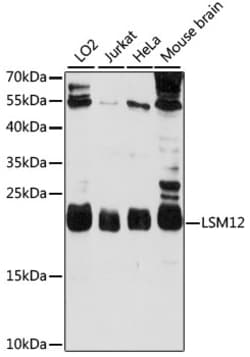
ABclonal Technology LSM12 Rabbit pAb
Nicotinic acid adenine dinucleotide phosphate (NAADP) binding protein (PubMed34362892). Confers NAADP sensitivity to the two pore channel complex (TPCs) by acting as TPC accessory protein necessary for NAADP-evoked Ca(2+) release (PubMed34362892). ( LSM12_HUMAN,Q3MHD2 )
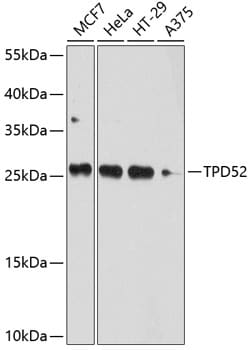
ABclonal Technology TPD52 Rabbit pAb
Enables calcium ion binding activity and protein homodimerization activity. Involved in B cell differentiation. Located in endoplasmic reticulum and perinuclear region of cytoplasm.
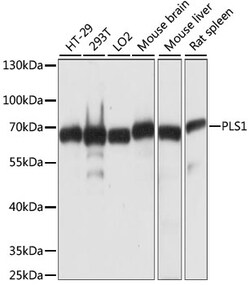
ABclonal Technology PLS1 Rabbit pAb
Plastins are a family of actin-binding proteins that are conserved throughout eukaryote evolution and expressed in most tissues of higher eukaryotes. In humans, two ubiquitous plastin isoforms (L and T) have been identified. The protein encoded by this gene is a third distinct plastin isoform, which is specifically expressed at high levels in the small intestine. Alternatively spliced transcript variants varying in the 5 UTR, but encoding the same protein, have been found for this gene. A pseudogene of this gene is found on chromosome 11.
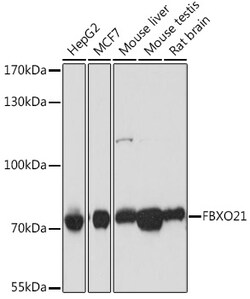
ABclonal Technology FBXO21 Rabbit pAb
This gene encodes a member of the F-box protein family which is characterized by an approximately 40 amino acid motif, the F-box. The F-box proteins constitute one of the four subunits of ubiquitin protein ligase complex called SCFs (SKP1-cullin-F-box), which function in phosphorylation-dependent ubiquitination. The F-box proteins are divided into 3 classes Fbws containing WD-40 domains, Fbls containing leucine-rich repeats, and Fbxs containing either different protein-protein interaction modules or no recognizable motifs. The protein encoded by this gene belongs to the Fbxs class. Alternative splicing of this gene generates 2 transcript variants.

S2 Media 15x100mm Chameleon™ COLOREX™ KPC (RUO), 10/pack
Chameleon™ COLOREX™ KPC (RUO) is a selective and differential, chromogenic culture medium used for the qualitative direct detection of gastrointestinal colonization with Carbapenem-Resistant Enterobacteria (CRE). Test specimens include rectal swabs and stools. For Research Use Only (RUO). Not for use in diagnostic procedures unless Laboratory Developed Test (LDT) validation with the product has been completed. Further identification, susceptibility testing, and epidemiological typing should be performed on suspect colonies.• Product meets CLSI performance criteria.• Chameleon™ COLOREX™ KPC should be used by trained professionals within a laboratory setting. • For in vitro diagnostic (IVD) use.• Product is not intended for use in the diagnosis or treatment of disease or other human conditions.
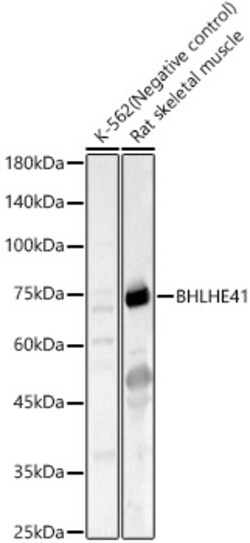
ABclonal Technology BHLHE41 Rabbit pAb
This gene encodes a basic helix-loop-helix protein expressed in various tissues. The encoded protein can interact with ARNTL or compete for E-box binding sites in the promoter of PER1 and repress CLOCK/ARNTLs transactivation of PER1. This gene is believed to be involved in the control of circadian rhythm and cell differentiation. Defects in this gene are associated with the short sleep phenotype.
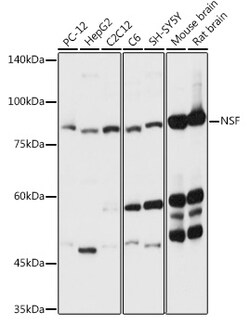
ABclonal Technology NSF Rabbit pAb
Enables PDZ domain binding activity and ionotropic glutamate receptor binding activity. Involved in intracellular protein transport, positive regulation of protein catabolic process, and positive regulation of receptor recycling. Located in Golgi apparatus, cytosol, and plasma membrane. Implicated in developmental and epileptic encephalopathy.
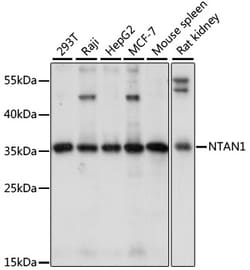
ABclonal Technology NTAN1 Rabbit pAb
The protein encoded by this gene functions in a step-wise process of protein degradation through the N-end rule pathway. This protein acts as a tertiary destabilizing enzyme that deamidates N-terminal L-Asn residues on proteins to produce N-terminal L-Asp. L-Asp substrates are subsequently conjugated to L-Arg, which is recognized by specific E3 ubiquitin ligases and targeted to the proteasome. Pseudogenes of this gene are located on the long arms of chromosomes 8, 10 and 12. Alternative splicing results in multiple transcript variants that encode different protein isoforms.
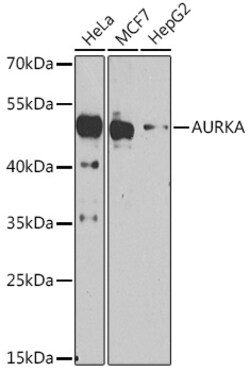
ABclonal Technology AURKA Rabbit pAb
The protein encoded by this gene is a cell cycle-regulated kinase that appears to be involved in microtubule formation and/or stabilization at the spindle pole during chromosome segregation. The encoded protein is found at the centrosome in interphase cells and at the spindle poles in mitosis. This gene may play a role in tumor development and progression. A processed pseudogene of this gene has been found on chromosome 1, and an unprocessed pseudogene has been found on chromosome 10. Multiple transcript variants encoding the same protein have been found for this gene.
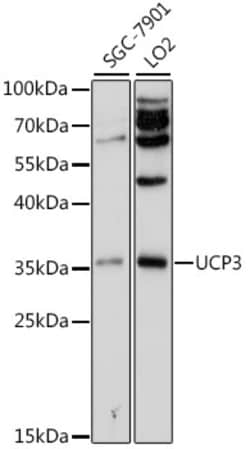
ABclonal Technology UCP3 Rabbit pAb
Mitochondrial uncoupling proteins (UCPs), part of the mitochondrial anion carrier proteins (MACP) family, dissociate oxidative phosphorylation from ATP synthesis, releasing energy as heat. UCPs transfer anions across the mitochondrial membrane and reduce the mitochondrial membrane potential in mammalian cells. This gene, primarily expressed in skeletal muscle, encodes a protein that may protect mitochondria from lipid-induced oxidative stress. Its expression increases when fatty acid supplies exceed mitochondrial oxidation capacity, aiding in fatty acid export. UCPs contain three solcar protein domains typical of MACPs. Two splice variants of this gene have been identified.
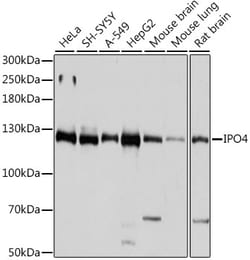
ABclonal Technology IPO4 Rabbit pAb
Predicted to enable nuclear import signal receptor activity and nuclear localization sequence binding activity. Involved in DNA replication-dependent chromatin assembly, DNA replication-independent chromatin assembly, and protein import into nucleus. Located in chromatin. Part of protein-containing complex.
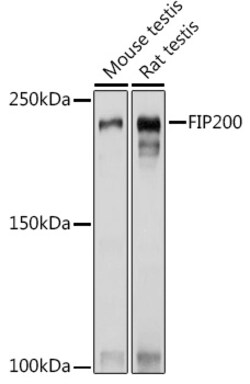
ABclonal Technology FIP200 Rabbit pAb
The protein encoded by this gene interacts with signaling pathways to coordinately regulate cell growth, cell proliferation, apoptosis, autophagy, and cell migration. This tumor suppressor also enhances retinoblastoma 1 gene expression in cancer cells. Alternative splicing results in multiple transcript variants encoding distinct isoforms.